Camino del Norte in Donostia / San Sebastián: where to drop your backpack for an afternoon in the city
You've walked in from Irún on the Camino del Norte and want to see La Concha and the Old Town without your backpack. 24/7 automated luggage storage in central Donostia, five minutes from the beach, bookable from your phone.
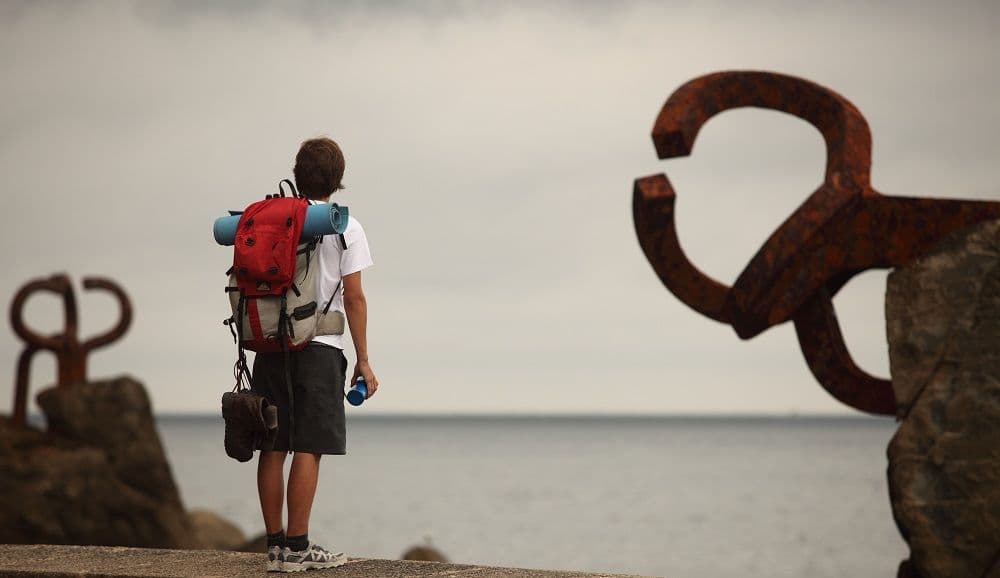
You've walked in on the Camino del Norte (the Coastal Camino). You started in Irún — after crossing over from Hendaye or Bayonne a couple of days ago — and today is the stage that ends in Donostia — usually around 2-4 PM if you set off early from Pasaia, a bit later if you stopped for pintxos along the way. The route brings you over Mount Ulía with spectacular Cantabrian views, and suddenly La Concha bay appears at your feet — probably the best arrival on the entire Camino del Norte.
And here's the decision every pilgrim faces: do I go straight to the albergue with the backpack still on, or do I want to see Donostia properly first?

Why drop the backpack for a few hours in Donostia
Camino albergues in Donostia (the municipal one at Ulía, private ones like A Room in the City or Green Nest) usually don't accept check-in until 2-4 PM, and once you've dropped the backpack, the Ulía albergues on the mount are quite far from the centre — going up for the backpack and back down eats half an afternoon.
If you arrive before opening, or you want to use the afternoon to see Donostia for real — not the four streets around the albergue with the backpack on — the practical move is to drop the backpack at a locker for 4-6 hours, walk light, do a pintxo route through the Old Town, dip your feet in La Concha, and pick up before you go to sleep (or before continuing to Zarautz if you're doing a double stage).
The reverse applies too: you slept in Donostia, you're leaving early tomorrow towards Zarautz or Orio, but you want breakfast in the Old Town first without hauling the backpack until the walk really begins.
And for pilgrims who take a rest day in Donostia — very common because the city is hard to leave, and because Aste Nagusia (15-22 August) or the Film Festival (late September) coincide with Camino high season — the locker is the obvious solution for the day without an albergue booking.
The Cantabrian Sea, the signature of the Camino del Norte

What makes the Camino del Norte different from the other Caminos is one thing: the sea never lets go. Stage after stage, the Cantabrian is there — sometimes as a horizon in the distance, sometimes as a cliff just below your feet, sometimes as a sandy beach you have to cross. The descent from Pasaia towards Donostia is probably the iconic moment of this first week: you spend hours climbing over Mount Ulía, and then the yellow arrow leads you down a stone stairway, with the bay and the beaches ahead. Worth every uphill hour.
And that's why the Norte pilgrim arrives at each city wanting beach and sea — not only medieval stone and cathedrals. Donostia is the perfect reunion with the coast after the mountain.
Donostia on the Camino map

Donostia is the first major stop on the Camino del Norte — the Coastal Camino — the route that leaves Irún, passes through Pasaia, Donostia, Zarautz, Deba, Markina, Gernika, Bilbao, Castro Urdiales, Santander... all the way to Santiago along the Cantabrian coast. It's the second most-walked Camino in the Peninsula after the Camino Francés, but with a distinctly different pilgrim profile: more international (many Germans, Dutch, southern French), more experienced (rarely anyone's first Camino), and more athletic (stages with sharper climbs).
Donostia is also the starting point of the Camino Vasco del Interior, a variant that turns south through Hernani → Tolosa → Vitoria-Gasteiz → joining the Francés in Burgos. Fewer pilgrims, more solitude, more mountain.
Most backpacks we store in August and September come from the Camino del Norte, but we also welcome pilgrims on the Vasco del Interior and those coming down from France via less-known variants.
Where we are in Donostia
DSS Lockers is at Calle San Martín Kalea 46, in the Centro district of Donostia — just a few minutes' walk from every point the Camino passes through and from the Old Town where the albergues are:
- La Concha beach — 5 minutes on foot
- Boulevard (main pilgrim thoroughfare) — 12 minutes on foot
- Plaza de la Constitución (Old Town, heart of the pintxo bar scene) — 14 minutes on foot
- Catedral del Buen Pastor (official pilgrim stop) — 6 minutes on foot
- Iglesia de Santa María del Coro (Old Town, Credencial stamp) — 15 minutes on foot
- Train station (Estación del Norte) — 10 minutes on foot
- Bus station — 9 minutes on foot
- Bus up to Mount Ulía (municipal albergue) — accessible from the Boulevard
_800x800.webp)
The location does exactly what a pilgrim needs: drop the backpack close to the Old Town, sightsee the centre and La Concha, and recover the backpack without detours before heading to the albergue or continuing to Zarautz.
How it works: 100% unstaffed access
This is the operational detail that makes DSS Lockers different: the shop has no staff on site during business hours. Everything runs between the street and your phone, in two layers:
- Pincode to enter the shop. Each booking generates a unique numeric code that you enter on the keypad by the door. The shop unlocks; you walk in.
- QR to open your locker. Once inside, you scan your QR code at the central kiosk. Your assigned locker opens automatically. Drop the backpack, close the door, and go.
On return, the same pincode reopens the shop, the same QR reopens the locker. The whole process — arrival, drop-off, pick-up — runs without human interaction, 24 hours a day.
You can book from your phone even while walking — if you have signal between Pasaia and Donostia, or between Hondarribia and Irún, booking takes under a minute: pick size and time.
We offer three locker sizes:
- S (small) — for handbags, cameras, wet rain jackets
- M (medium) — for a standard pilgrim backpack (35-50 L)
- XL (extra-large) — for a full trekking backpack (60-80 L with poles and rolled sleeping bag)
Another useful detail: if your backpack came in wet (the Cantabrian rains even in August), the locker is climate-controlled — you're not leaving damp clothes in a closed space at room temperature for hours.
What to see in Donostia with the backpack off
Four to five hours is plenty for the essentials. Route we recommend (and the one pilgrims taking a rest day appreciate most):
- La Concha beach — mandatory. Dip your feet in the water, walk the promenade end to end (about 40 min return) to Chillida's Peine del Viento sculpture.
- Old Town (Parte Vieja) — Plaza de la Constitución, 31 de Agosto street, Iglesia de Santa María del Coro. Get your Credencial stamped here (or at the Catedral del Buen Pastor).
- Pintxo route — Bar Nestor (legendary tortilla), Ganbara (mushrooms), La Cuchara de San Telmo (foie), Bergara (birthplace of the Gilda). Five quality pintxos for €20-25. Fair warning: in Donostia pintxos are paid, not free like elsewhere in Spain.
- Mount Urgull — 20-min climb from the Old Town to the Christ statue. Spectacular views of the whole bay. Perfect for pilgrims who barely notice hills anymore.
- Peine del Viento (Chillida) — western tip of the bay. Sculpture + Cantabrian waves crashing. Spectacular at sunset.
- Kursaal + Zurriola — Donostia's other beach, the surf one. Different vibe than La Concha.
- Mount Igueldo — funicular from the end of La Concha up to the viewpoint. Panoramic bay view. Optional if you're pressed for time.
Four hours covers 1-3 well plus a quick loop of 4-5. Full afternoon adds the pintxos and the Peine del Viento, and you leave Donostia with the feeling of having actually visited the city, not just slept at the albergue.
Practical tips for Camino del Norte pilgrims
- Book before you arrive in peak season. From June to September occupancy can be high, especially in August during Aste Nagusia and in the Film Festival weeks. Booking from your phone on the Camino takes a minute.
- Keep the essentials in a separate pocket: passport, cash, phone, charger, pilgrim credential. You don't want to come back to the locker just to grab the credencial when Santa María stamps.
- Change of footwear: experienced pilgrims leave the trekking boots in the locker and go walk La Concha in sandals or light shoes. Your feet will thank you.
- Wet clothes can stay in the locker — it's climate-controlled, no problem.
- The next stage (Donostia → Zarautz, 22 km) starts by climbing Mount Igueldo. It's a demanding day for the elevation gain: if you had a long day today, consider sleeping in Donostia and starting fresh at dawn.
- If you come in August during Aste Nagusia, occupancy peaks and lockers fill up. Book 2-3 days ahead minimum.
- If you come in late September during the Film Festival, on top of regular tourism the city fills with press and industry — same recommendation to book ahead.
Ongi etorri Donostiara — buen Camino
The Camino del Norte isn't only walking the coast — it's also meeting Donostia, probably the most beautiful city on the entire route. Drop the backpack for a few hours, walk light, eat pintxos in the Old Town, dip your feet in La Concha, and return to the Camino with rested legs and a city you actually know.
Ongi etorri Donostiara. And when you pass Zarautz tomorrow, or Getaria the day after, you'll know La Concha was worth the hours you gave it today.